That seemed to feel like a very long train ride. After nearly three days on the train I was ready to get off, which I did mid-afternoon. A few hours out of the city rubbish could be clearly seen dumped in the towns and villages, something I had not seen previously. A pity really as there had been little rubbish seen previously. I was met at the station and taken to the Hotel Primorie which was only about a five minute walk from the railway station.
I arranged with the driver (and bargained about the cost) to be picked up the following morning and he would take me round to the places i wanted to go to and others that he suggested. I did walk round for a couple of hours but it was cold and windy taking the temperature down to –18C in the evening.
The first stop the following morning was at the Egersheld Lighthouse (or Tokarevskiy Lighthouse) on the Tokarevskiy Spit. Tokarevsky Spit is almost 800 meters in length and is a man-made island created as the foundation for the lighthouse, and a narrow damn was also built to connect it to the shore. Built in 1876, the Tokarevsky Lighthouse is one of the oldest operating lighthouses in the Russian Far East. The white tower on the octagonal foundation was erected in 1910; the height of the lighthouse tower is 11.9 meters. (photo taken from the web).
 |
| Looking towards the Golden Horn |
 |
| The access spit |
The passenger ship wharf was next, this being next to the railway station. One of the problems in Vladivostok was finding a parking place as there were too many cars about. People get fined quite often the guide said but we did find somewhere to park after driving round for a while.
 |
| The bay from the passenger terminal |
The Russian Navy has a number of bases here and at midday fire a salute at the base not far from the passenger terminal. I was taken there but first looked at and went inside an old submarine, the S-56 which was mounted ashore near the naval base. The S-56 class submarine, built in Leningrad in 1936, was dismantled and transported on the Trans Siberian railway to Vladivostok where she was rebuilt in 1941. After decommissioning, the she was turned into a museum ship.
 |
| S-56 from the bow |
 |
A general view inside S-56
|
 |
| A torpedo |
 |
| The torpedo tubes |
 |
| S-56 from the stern |
I noticed that were being allowed into the naval base to witness the gun salute. The guards refued me entry when I tried saying that there was also a parade for the crew of a ship that had just come back from patrol and because I was a foreigner as well. I was able to watch the parade from the sea wall and was surprised when the Russian National Anthem was played from a recording and not by the band that was present for the parade. Maybe because the band was not very good anyway.
 |
| The Naval Band |
 |
| Ships under review |
From the sea wall I could see the new Russian Orthodox Cathedral being built so I took a photo of the domes which I thought were special, and the only parts not covered in scaffolding.
 |
| The cathedral domes |
Nearby was the Nicholas II Arch built in 1891 to commemorate the heir’s to the Tsar’s throne Nicholas Alexandrovich’s – later he became Russian Imperator Nicholas II.
 |
| Nicholas II Arch |
The Zolotoy Bridge (or Golden Bridge) crosses the Golden Horn but also because it looks a remarkable structure in itself.
 |
| Add caption |
 |
| The view from the other side of the water |
There is a small funicular here which is 56 years old and used daily by curious tourists and local students. And that is justified by the fact that Far Eastern Federal University's - one of the main higher education facilities in Primorsky Krai - buildings are located near funicular's upper and lower stops. It is also the way to a lookout to see over the Golden Horn.
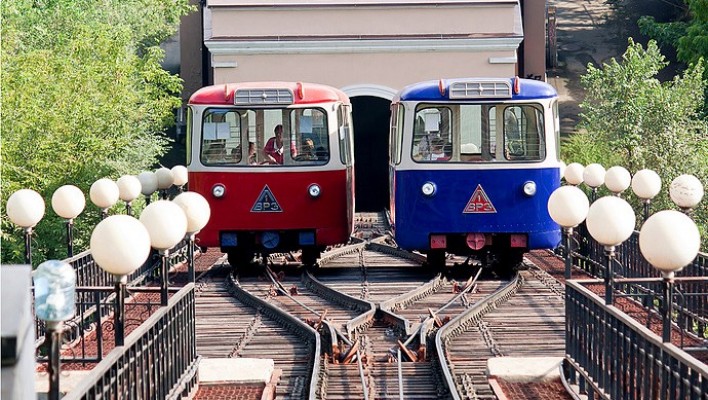 |
| The Funicular |
There are seven forts on Russky Island which were built to protect Vladivostok and the Russian Fleet with it’s bases from the Japanese during the Russo-Japanese War of 1905. The forts performed this function until the late 20th century and remained a closed territory the whole time. None of the guns were ever fired in anger, such a waste of money people think now. It wasn’t until 1992 that Vladivostok was open to foreigners.
 |
| One of the batteries facing the Sea of Japan |
 |
| One of the guns |
 |
| The sea in-front of the guns |
 |
| Looking towards the Sea of Japan |
Further round the island was the Voroshilov Battery with two turret launch facilities taken from the battleship "Poltava’’. The 305-mm turret artillery battery was the first and the last battery of such high caliber created in the soviet period. Fortunate location and powerful fortification facilities made it virtually invulnerable for enemy's fire. Battery's turrets were connected by underground 250-meter long passage. Each of them had three stories of underground ammunition stores, living quarters and maintenance rooms underneath it. Thanks to three-meter thick concrete vault, the Voroshilov Battery could withstand a hit by an aircraft bomb weighing one ton. Its guns were able hit targets at 35 kilometers' distance, and all six weapons could be brought in motion simultaneously. The battery fired its first shot in 1939. It should be noted that, being over 63 years on action station the battery fired only practice shots.
 |
| One set of guns |
 |
| Shells |
 |
| The open gun breech |
 |
| Looking into the gun chamber |
 |
| A schematic of the installation |
There was also another part to the museum with tanks and vehicles (and one odd machine).
 |
| A Japanese made steam roller |
On the way back to the hotel the guide stopped at the Cathedral of the Intercession of the Virgin Mary, originally built in 1902 it has had a tragic history since. When the Soviets came to power the cathedral began to decay. In 1923, the cemetery was closed and in 1934, it was turned into a public park; the graves were razed to the ground and the marble plates were reused in various constructions. In 1935 the temple was blown up. The cathedral was fully reconstructed only in 2004.
 |
| Inside the Cathedral |
 |
| The Cathedral |
That was the end of a long, interesting and very enjoyable day. The submarine and the gun batteries were so interesting and perhaps something I could not have seen anywhere else. Supposing someone wanted to visit Russia and ride on the Trans Siberian railway then I suggest that it be done in winter as besides there being fewer tourists the snow makes everything magical, the snow and the cold not a hindrance in any way.
On 25 January I flew to Harbin in China. There was somewhat of a possible problem with immigration in Vladivostok as I think they were not used to a foreigner flying in that direction but I had forestalled this by getting a full two year multiple entry visa for China before leaving the UK. I’ve since found out that some passport holders can obtain a visa on entry to China BUT different entry points have different lengths of travel if this system is used.


