Getting to Vladivostok airport was no problem but booking in for the flight to Harbin was a little stressful. I was asked for my China visa which I said was in my passport. I had obtained a full two year multiple entry visa before leaving the UK as the visa waver for China has requirements about entering and leaving through the same airport which I was not able to do. The man then called over a supervisor, there was a discussion, then they phoned someone and then booked me in. I can only assume that not many Europeans travel between Vladivostok and Harbin so they were not used to this. The full China visa certainly helped I’m sure.
 |
| Nearing Harbin |
The flight to Harbin was good but when I picked up my bag I found it to be ripped and beyond further use. I suppose I was lucky that nothing had fallen out of the bag. When I reported the damage I was told just to buy another bag as Ural Airlines would not reply to any claim for weeks and by then I’d have left China. Not a very happy bunny! I had booked a room at the Harbin Xi Long Shi Zhong Inn but when I arrived there I found it to be a further way out of the city centre than I expected. The receptionist helped me to re-book at the Ibis Harbin Sofia Church Hotel which was two streets over from the central part of the city and had a tour desk in the lobby. The hotel staff spoke very little English but the people at the tour desk helped when necessary. I did find out that the tour desk was only operating when the Ice Festival took place as that is when most tourists visit Harbin.
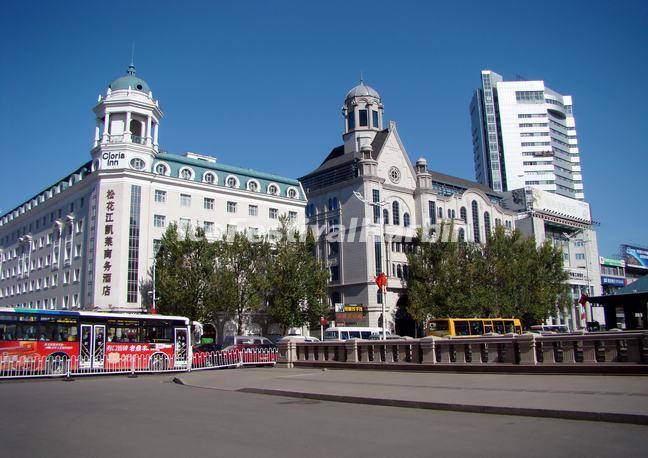
During the times I walked round Harbin city it was easy to see that it had been colonised in the past by the number of old buildings in the city. A lot of them had plaques indicating what they had been built or used for and the original date of building was set into
the structure. The oldest date I saw was 1901. Harbin grew from a small village in 1898 into the modern city of Harbin. During the Russian-Japanese War (1904–05) Russia used Harbin as its base for military operations in Manchuria. Following Russia's defeat, its influence declined. Several thousand nationals from 33 countries, including the United States, Germany, and France, moved to Harbin. Churches were rebuilt for Russian Orthodox, Lutheran, German Protestant, Polish Catholic and Christians.
In 1913 the Chinese Eastern Railway census showed its ethnic composition as: Russians – 34313, Chinese – 23537, Jews – 5032, Poles – 2556, Japanese – 696, Germans – 564, Tatars – 234, Latvians – 218, Georgians – 183, Estonians – 172, Lithuanians – 142, Armenians – 124. There were also Karaims, Ukrainians, Bashkirs and some Western Europeans. In total, 68549 citizens of 53 nationalities and speaking 45 languages. Research shows that only 11.5 percent of all residents were born in Harbin. I think that I would have liked to have been there at that time!
I called into the Central Street tourist office, which itself was in a lovely old building and was lucky enough to be able to watch a video of what Harbin used to be like during the colonial times. It showed people playing tennis; ladies having afternoon tea; dinner parties under the trees, drinking at the yacht club and sailing on the river. Rarely was there a Chinese person to be seen and it brought to mind how the colonials lived, even in this part of China. One American in the past said that it looked like a ‘boom-town,’ displaying the same characteristics shown by San Francisco during the California gold rush. photo.
 |
| Views of Harbin taken from the internet |
On a walk to see what was called a ‘railway park’ I came across a little park with some beautiful ice carvings. I visited the park a number of times as I thought they rivaled the carvings at the main festival park outside the city. I then find out that every park in the city had it’s own display, mainly by local artists I think and paid for by local businesses and the community. Even in the main streets there were ice carvings and it amazed me that none had any water dripping off them even with the sun shining on them. Perhaps the temperature averaging between -6C to –16C helped with the humidity being very dry.
 |
| Main street ice sculptures |
 |
| Park sculptures at night |
 |
| Community Centre in one of the parks |
I walked to the ‘railway park’ to find one old steam engine on display outside the old Harbin railway station. The engine and station looked good from the outside and inside the station was a museum recording the building of the railway which was very interesting to wander round. The building itself was beautiful inside.
 |
| The old engine and bridge |




No comments:
Post a Comment